We researched over 20 digital multimeters to compare their performance directly. We tested their measurement capabilities on both delicate digital circuits and typical residential electronics. We rated their ease of use, included probes, AC/DC measurement functions, and other features. Our hands-on evaluations highlight the best meters for beginners, high-end applications, and those offering the most functionality for testing electrical systems.
Summary of Recommendations
- Fluke 117 Electricians True RMS — best overall — Jump to review
- AstroAI 6000 — best budget — Jump to review
Best Overall
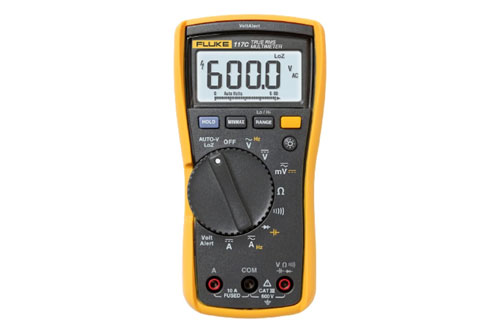
1. Fluke 117 Electricians True RMS
What we like
- Allows you to take very technical measurements
- An exceptional suite of AC measurement abilities
- Integrated non-contact voltage probe
What we don't like
- Expensive
- No dedicated transistor sockets
The Fluke 117 is a highly specialized meter designed for professional use, particularly by electricians. It boasts advanced features like a non-contact AC probe and a clear, intuitive interface. This true-RMS meter includes a low-impedance input that automatically detects and selects the appropriate voltage range. Additionally, a separate current probe can be purchased for measurements above 10 amps.
While the Fluke 117 excels in technical measurement functions, it’s more suited for home or commercial wiring rather than hobbyist DC circuits. It's also priced higher than what most amateurs would prefer and lacks NPN/PNP transistor testing. Despite this, it remains an excellent professional-grade multimeter, though more specialized than what many projects might require.
Best Budget
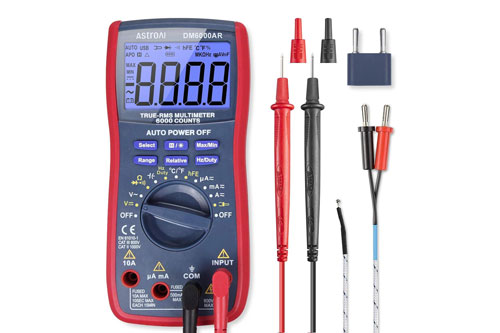
2. AstroAI 6000
What we like
- Very easy to use
- Tons of measurement capabilities
- Large display
What we don't like
- Kickstand is difficult to deploy
- Universal socket for component measurements is finicky
The AstroAI 6000 is a favorite among electronic hobbyists thanks to its strong mix of performance and value. It offers a wide range of AC and DC measurement capabilities, along with added features for testing transistors, diodes, resistors, capacitors, and temperature via thermocouple. That versatility makes it well suited for benchtop prototyping, sorting components, DIY electronics, household wiring repairs, and troubleshooting 12 and 24 VDC systems in cars and boats.
It does have a few minor drawbacks. The magnetic hanger is not very strong and tends to attract metal debris, the kickstand can be difficult to unfold, and the probe covers are somewhat tough to remove. Its larger size makes it better suited for bench work than tight spaces, and its tolerance is slightly higher than some competing models, though this will not matter for most users. Even with these small issues, the AstroAI 6000 remains an excellent and highly recommended multimeter for hobbyists.