If you're planning to hang anything over 20 pounds in your home, it's essential to use a stud finder to locate the studs and joists needed to anchor your items securely. Stud finders come in two main varieties: magnetic stud finders, which detect studs by sensing the nails and screws within them, and electronic stud finders, which identify wood, metal, and sometimes electrical wiring by detecting changes in electrical flow.
To identify the best stud finders for various projects, we tested them on a set of custom-built walls under different construction scenarios. After thorough testing, our team of experts and beginners found options that cater to DIYers of all skill levels.
Summary of Recommendations
- Franklin Sensors 710 — best overall — Jump to review
- Craftsman 3/4-Inch Depth Stud Finder — best budget — Jump to review
- Mecurate Stud Finder — best for plaster walls — Jump to review
Best Overall
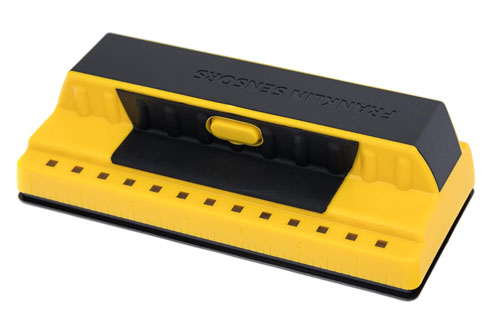
1. Franklin Sensors 710 Professional Stud Finder
What we like
- Wide coverage
- Accurate, fast results
- Always in deep scan mode
What we don't like
- Doesn't detect live wires
- Indicates the presence of metal pipes and studs, but does not differentiate between them
The Franklin Sensors ProSensor 710 Precision stands out for its accurate and detailed wall detection. Its 13 sensors simultaneously scan behind walls (and floors) to locate wooden studs and metal objects like pipes with precision. Unlike some other stud finders, it requires no calibration and shows both the edge and center of studs instantly.
We appreciated how quickly and accurately the ProSensor 710 identified studs, both wood and metal. The device’s wide 7-inch length enhances accuracy and speed, and its 13 LED indicators clearly mark stud edges and centers. It performed well on plaster, drywall, and paneling, with a detection depth up to 1.6 inches. However, it doesn’t detect live wires or have a battery life indicator.
The ProSensor 710 runs on two AA batteries.
Best Budget
2. Craftsman 3/4-Inch Depth Stud Finder

What we like
- Small and lightweight
- Reasonable price
- Easy to use
What we don't like
- Requires you to measure for the center of the stud
- Does not detect live wires or pipes
- Best on drywall, not other materials
This affordable stud finder is a straightforward tool for detecting wood and metal studs, but it doesn't locate electrical wiring or pipes. It’s easy to calibrate—just hold the button until the red light turns off—and simple to use.
Unlike premium models, it doesn’t find the center of a stud automatically. You move it along the wall until a red light and beep indicate the edge, mark it, and repeat from the opposite side to find the other edge. Then, measure between the marks to find the center. Though this method might seem tedious, it was easy and accurate in our tests, especially on drywall, though it struggled on paneling or plaster.
The Craftsman stud finder has a 3/4-inch detection depth, sufficient for most studs except in areas with double-layered sheetrock. It’s small, lightweight, and runs on a 9-volt battery (not included).
Best for Plaster Walls
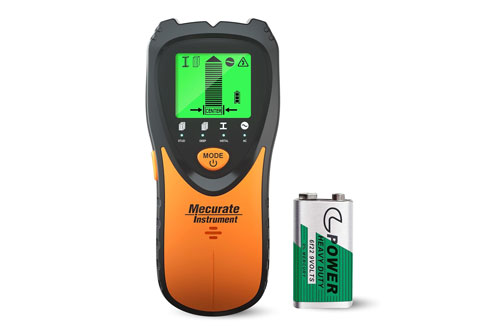
3. Mecurate Stud Finder
What we like
- Performs very well over plaster
- Detects live wires
- Deep scan mode
What we don't like
- Does best with very slow passes over the wall
While newer homes typically have drywall, many older homes still feature plaster walls, which can challenge most stud finders. If your house has plaster walls, we recommend the Mecurate Wall Scanner. In our tests, this device excelled at detecting wood and metal studs, as well as live wires beneath plaster. It also worked well on drywall and paneling, though it required slower passes for consistent accuracy on these surfaces.
The Mecurate Wall Scanner offers four modes: stud mode with 3/4-inch detection depth, deep mode with 1.5-inch depth, metal mode for 2-3/8-inch depth, and AC mode with 2-inch depth. An audible beep and LED indicators help quickly locate studs, and it clearly shows both edges and the center of the stud. The backlit display is easy to read, even in dim lighting.
Powered by one included 9-volt battery, this stud finder also features a battery life indicator so you can monitor power levels.